
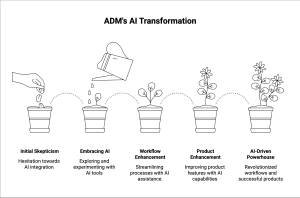
This document chronicles the journey of ADM, as they embrace and elevate Artificial Intelligence (AI) to revolutionize their workflows, enhance their products, and ultimately, achieve unprecedented success. From initial skepticism to full-fledged integration, this story illustrates how CoderHQ transformed itself into an AI-driven powerhouse.
Chapter 1: The Dawn of Doubt
ADM, a team of seasoned developers, prided itself on its craftsmanship. Every line of code was meticulously crafted, every algorithm carefully optimized. When the buzz around AI started growing, it was met with a mixture of curiosity and apprehension.
“AI? That’s just hype,” muttered Sarah, the lead architect, during a team meeting. “It’s not going to replace us. We’re problem solvers, creative thinkers. AI can’t replicate that.”
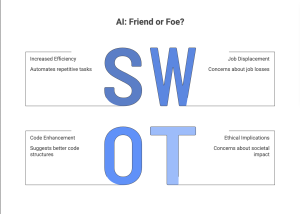
Mark, a junior developer, was more optimistic. “But imagine the possibilities! AI could automate repetitive tasks, help us debug faster, even suggest better code structures.”
The debate raged on, but the management, recognizing the potential, decided to initiate a pilot project. They tasked a small team, led by Mark, to explore how AI could be integrated into their existing workflow.
Chapter 2: The First Steps
Mark’s team started small. They began by experimenting with AI-powered code completion tools. Initially, the suggestions were often irrelevant or even incorrect, reinforcing Sarah’s skepticism.
“See? I told you,” she said, shaking her head. “It’s just generating garbage.”
But Mark persisted. He fine-tuned the AI models, providing feedback and training them on CoderHQ’s specific coding style and project requirements. Slowly, the suggestions became more accurate and helpful.
They also explored AI-powered testing tools. These tools could automatically generate test cases, identify potential bugs, and even suggest fixes. This significantly reduced the time spent on manual testing, freeing up developers to focus on more complex tasks.
Visual: A dashboard showing the results of an AI-powered testing tool, highlighting potential bugs and suggesting fixes.
Chapter 3: Overcoming Challenges
The integration wasn’t without its challenges. One major hurdle was data privacy. CoderHQ worked with sensitive client data, and they needed to ensure that the AI models were trained and used in a way that protected this data.
They implemented strict data anonymization and encryption protocols. They also chose to use on-premise AI solutions, rather than relying on cloud-based services, to maintain greater control over their data.
Another challenge was the learning curve. Developers needed to learn how to effectively use the AI tools and how to interpret their results. CoderHQ invested in training programs and workshops to help their team upskill.
Chapter 4: The AI Advantage
As the team became more comfortable with AI, they started to see its true potential. They used AI to:
-
Automate repetitive tasks: Generating boilerplate code, writing documentation, and deploying applications.
-
Improve code quality: Identifying potential bugs, suggesting code improvements, and enforcing coding standards.
-
Enhance collaboration: Providing real-time feedback on code changes and facilitating knowledge sharing.
-
Personalize user experiences: Analyzing user data to provide tailored recommendations and support.
Sarah, initially the biggest skeptic, became one of AI’s biggest advocates. “I was wrong,” she admitted. “AI isn’t going to replace us, but it’s going to make us better. It’s like having a super-powered assistant that can handle the mundane tasks, freeing us up to focus on the creative and strategic aspects of our work.”
Chapter 5: Elevating the Product
CoderHQ didn’t just use AI to improve their internal processes; they also integrated it into their products. They developed AI-powered features that enhanced the user experience and provided valuable insights.
For example, they built an AI-powered search engine that could understand natural language queries and provide more relevant results. They also developed an AI-powered chatbot that could provide instant customer support.
These AI-powered features gave CoderHQ a significant competitive advantage. Their products were more user-friendly, more efficient, and more intelligent than their competitors’.
Chapter 6: The Future is Intelligent
CoderHQ’s journey with AI is far from over. They are constantly exploring new ways to leverage AI to improve their products and processes. They are experimenting with:
-
Generative AI: Using AI to generate new code, designs, and content.
-
Explainable AI (XAI): Developing AI models that are transparent and understandable.
-
AI-powered security: Using AI to detect and prevent cyberattacks.
CoderHQ’s success story demonstrates that AI is not a threat to developers; it’s a powerful tool that can help them achieve more. By embracing AI and integrating it into their workflows, CoderHQ has transformed itself into an AI-driven powerhouse, ready to tackle the challenges of the future.